



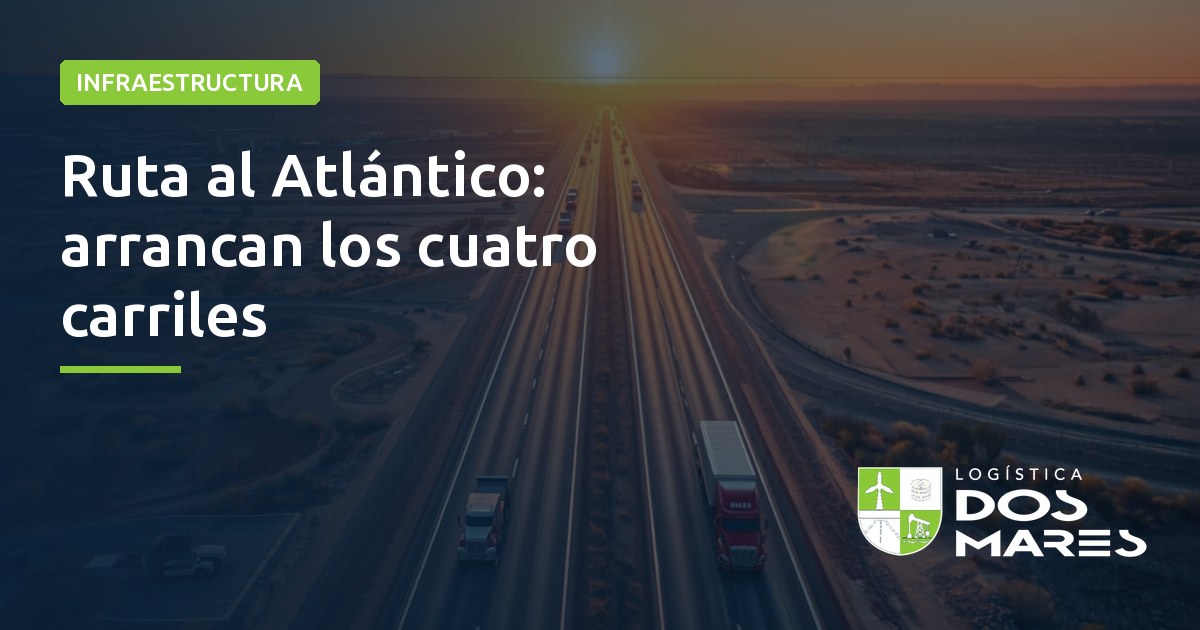
On November 13, 2026, work began on one of Guatemala's most anticipated road projects: widening the Atlantic Highway (CA-9 Norte) to four lanes between El Rancho, El Progreso, and Teculután, Zacapa. The section is 31.8 kilometers long, from km 86.8 to km 118.7, with an investment of US$175 million and a 36-month schedule, according to the Ministry of Communications, Infrastructure and Housing (CIV).
For those of us who build infrastructure between two oceans, this is not just another project. It is the first step toward giving Guatemala's gateway to the Caribbean the capacity that the country's trade already demands.
A highway that fell short
The CA-9 Norte was designed for about 6,000 vehicles a day. Today it carries up to 20,000, more than three times as many. More than 60% of the country's exports travel along it to the Caribbean ports, and the expansion will benefit more than 350,000 residents of El Progreso and Zacapa, according to CIV figures cited by Infobae.
With one lane in each direction, any incident, a broken-down truck or a rain-damaged stretch stops freight, public transport and local traffic all at once. The expansion delivers two lanes in each direction, separated by a central median and with side shoulders.
What the project includes
The project is about more than adding asphalt. According to Minister of Communications Norma Zea, in the presentation reported by Soy502, the work includes:
- Rehabilitating the existing lanes and building two new ones, so all four have the same structural strength.
- Removing 8 to 10 cm of existing pavement, improving the base and laying about 18 cm of asphalt mix.
- Replacing six bridges that have been in service for more than 50 years, including the one over the Hato River, with 12 new structures: a twin bridge at each crossing.
- Greater load capacity: the current bridges were designed for about 20 tons; the new ones will carry up to 70.
That last point is key for heavy logistics. An export corridor with 20-ton bridges limits what cargo can pass and forces detours. With 70-ton structures, the route matches the kind of transport that actually uses it.
Building while traffic keeps moving
Widening a highway that cannot be closed is one of the toughest challenges in road engineering. According to Emisoras Unidas, the execution plan includes:
- A first stage of about 90 days to set up camps, move in machinery and prepare the equipment that will produce construction materials.
- Two lanes open throughout the project, using the space along the sides of the road.
- New bridges built next to the existing ones, with temporary structures where needed, so traffic is never cut off.
- Night work for some activities, to reduce the impact on traffic.
That is where a project like this succeeds or fails: in logistics planning, in having the right machinery on the right front, and in completing each stage on time.
International financing and resilient design
The investment combines US$75 million from an Inter-American Development Bank (IDB) loan and US$100 million from an agreement with the Spanish Agency for International Development Cooperation (AECID) and Spain's Official Credit Institute (ICO). According to the Spanish ambassador, it is the first sovereign loan from the Spanish Sustainable Development Fund granted to Guatemala.
The financing includes climate adaptation, road safety and institutional strengthening measures. The IDB plans nature-based solutions to reduce flood and erosion risk, which is essential on a route that every rainy season puts to the test.
The full corridor: from the Pacific to the Caribbean
El Rancho–Teculután is only the first stage. According to Infobae, contracting is already under way for the design studies of the Teculután–Mayuelas section, and Taiwan plans to tender the studies for Mayuelas–Puerto Barrios. The goal is to take the four lanes all the way to Izabal.
At the same event, President Bernardo Arévalo linked the project to other foreign-trade initiatives:
- The expansion of the ports of Santo Tomás de Castilla, on the Atlantic, and San José, on the Pacific.
- The recovery of the Puerto Quetzal–Escuintla railway line.
- Talks on a future rail connection with Mexico.
Add to this the new port system law, Decree 20-2026, in force since October 2, 2026, which reorganizes the institutions that run the country's ports. Roads, ports and railways moving forward together: that is how a true corridor between two oceans is built.
What lies ahead for Guatemalan infrastructure
A 36-month project with international financing, climate-resilience standards and twelve new bridges sets the bar Guatemala needs for its road network. It calls for builders with experience in public works, heavy-machinery capacity and the discipline to meet deadlines without bringing the country to a halt.
At Logística Dos Mares we have worked since 2007 on road, port and airport civil works, and on heavy-machinery leasing. That is why we welcome the Caribbean corridor beginning to grow at the pace of trade: every kilometer that better connects the Pacific with the Atlantic brings Guatemala closer to its potential as a bridge between two seas.